What is Linguistically Responsive Education?
Linguistically responsive education meets the needs of all learners and recognizes and supports all languages as assets in developing an inclusive, innovative and socially just society. Language is the foundation of how we express identity and interact with the world. Contexts that move beyond tolerance to appreciating, adapting and adopting languages can improve their intercultural communication skills to engage in our globalized world.
What is Language?
"Language is at the heart of the learning process (Derewianka & Jones, 2012, p. 2)." According to Derewianka and Jones, through language, we learn about language, gain knowledge of the world, connect worlds such as the home, community explore different subjects and literature as well as build identity. People also use language for different purposes and context in the form of everyday language used outside of school and academic language used in school such as explaining, recounting and describing subject area mediums and modes. Michael Halliday conceptualizes language as a meaning making system. The way people interact with and interpret the world shapes our reality and selves, thus making meaning. When using language, people make different language choices depending on the:
1. Field- content and subject matter
2. Tenor- Roles of ourselves and others
3. Mode- Channels (spoken, written, visual, multi-modal)
Together, the field, tenor and mode are the register of a context/situation. Influencing register, we need to consider the context (beliefs, values and behaviors) within a situation because language systems develop overtime in a culture to meet specific needs.
Ultimately, language choices depend on individual purposes. According to Derewianka and Jones, we achieve our social purpose through genres / text types which include traditional texts (literature, art, science fiction genre and so forth), but also non-literary texts (casual conversations, reviews). The authors identify three functions of language:
1. Expressing ideas (ideational function)
2. Interacting with others (interpersonal function)
3. Theme and cohesion (textual function)
1. Field- content and subject matter
2. Tenor- Roles of ourselves and others
3. Mode- Channels (spoken, written, visual, multi-modal)
Together, the field, tenor and mode are the register of a context/situation. Influencing register, we need to consider the context (beliefs, values and behaviors) within a situation because language systems develop overtime in a culture to meet specific needs.
Ultimately, language choices depend on individual purposes. According to Derewianka and Jones, we achieve our social purpose through genres / text types which include traditional texts (literature, art, science fiction genre and so forth), but also non-literary texts (casual conversations, reviews). The authors identify three functions of language:
1. Expressing ideas (ideational function)
2. Interacting with others (interpersonal function)
3. Theme and cohesion (textual function)
Benefits of Multilingualism
|
Hoff (2018) findings suggest the quantity and quality of students' exposure to the language of school and their heritage language reflect language competencies in each language. Therefore, students who are exposed to both languages at an early age will become competent based on the "extent required by his or her needs and those of the environment" (Grosjean, 1989, p. 6). This also suggests that the beliefs upheld in society about the importance of both languages directly affect language competencies and furthermore, how the two languages are used and to what degree. In thinking about multilingual development, language should be used in rich, authentic ways.
|
|
Language used at home and language used in school support language competencies especially with skilled, fluent speakers in either context. Early bilingual children may show a lag in the development of one or both languages, but this does not mean they are confused in their language. Early bilingual learners usually know more vocabulary words in total based on both of their languages compared to early monolinguals (Hoff et al., 2012). This has been demonstrated when examining what learners can express directly, expressive language, and vocabulary words learners can respond to in some way which is receptive language.

|
Toolkit Resources: Languages (First Language & English)
|
- Make Beliefs Comix by Bill Zimmerman & Tom Bloom. Kids can create their own comics in English, Spanish, French, German, Italian, Portuguese or Latin. It provides links on how to use it and tools for ELLs, SEN, parents. It also has writing tools and many additoinal features
- The Differences between English and Other Languages by Paul Shoebottom, Frankfurt International School. Useful information to understand the similarities and differences between English and other students' first language
- School Penpals & Key Pals by the Teacher's Corner. Ssearch for classes by grade level and geographic area
- Bilingual quizzes by the Internet TESL Journal. It includes quizzes in many different languages as well as grammar and vocabulary quizzes. Teachers contribute to the content, and it is leveled by language and difficulty level
- Awesome Library by EDI and Dr. R Jerry Adams. Resources are organized by language
- Casa Notes by 4teachers.org: It provides a large collection of notes available in English and Spanish
- Childtopia offers hundreds of resources in Spanish, English, French, Catalan and Basque. Some are free and others require a subscription
- International Children's Digital Library: Free digitized books from around the world in multiple languages
- Bilingual Book Ideas by Starbright Books
- Bilingual and Spanish/English integrated books by Cooperative Children's Book Center (Febry & Lindgren, 2018)
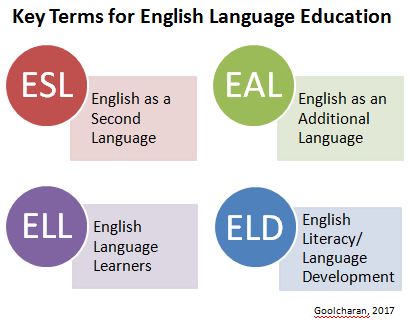
Who are English Language Learners (ELLs)?
|
1. Canadian-Born
All English Language Learners come with unique knowledge and skills and needs. There may be a gap in their formal schooling. Adapted from Supporting English Language Learners: A Practice Guide for Ontario Educators Grade 1-8 |
|
English Language Learners are an Asset
|
There are many benefits to including and supporting English Language Learners in learning communities as they bring unique languages, experiences and perspectives to schools. This enriches and empowers all learners because they have greater access to diverse experiences, perspectives and cultures beyond their own.
Does your school provide collaborative and inclusive opportunities and services for English Language Learners? What barriers exist for English language learners? Too often students who speak a home language other than English are seen as having "less ability, less motivation and less potential for success than mainstream students from middle class families" (Shields, 2013, p. 9). This greatly affects the success of English Language Learners and impacts their sense of self and social, emotional and academic growth. Another barrier affecting English Language Learner is how educators and leaders view language in schools. Schools need to move beyond viewing language as a problem that needs to be fixed to viewing language as a right and resource for social justice (Crawford, 2004; Reyes, 2006; Ruiz, 1984). Language is a right, and all students should have equal access to educational opportunities. Language is a resource, and the languages of English Language Learners enrich learning environments for their own learning and for others in the school and community. Prepare for English Language Learners
With the growing English Language Learner population expecting to double by 2050 (Meskill, 2005), educators and other leaders need to welcome and ensure inclusive education for English Language Learners and their families. To achieve this, schools should provide "equitable and excellent education for English Language Learners [as] an essential component of social justice leadership" (Theoharis & O'Toole, 2011, p. 648). To ensure this, language learners' needs should be accommodated and there is not necessary one method that fits all situations. When possible, separate EAL classrooms should be replaced with inclusive practices. According to Theoharis & O'Toole, schools should integrate ESL programs and services and diverse cultures and languages into mainstream classrooms in the school community (Theoharis & O'Toole, 2011). Within the mainstream classrooms, English Language Learners should have similar high expectations paired with high quality instruction and engaging learning opportunities (Shields, 2013). The main difference between immersion and inclusion is English Language Learners are given many kinds of supports from their classroom teacher and others which may include linguistic support from resource teachers and bilingual paraprofessionals. However, each individual is different and students, especially those who have experienced trauma or have interrupted schooling may need to gradually move into mainstream classes. This gradual process may take weeks, months and so forth, but should eventually aim for the mainstream classroom when it is appropriate. It is important to involve stakeholders in decision making to ensure all students have the supports to succeed within the classroom and beyond.
|
What are some of the benefits of speaking more than one language?
1. Greater access to information 2. Greater access to opportunities 3. Greater understanding of people: cultural cues and mindsets 4. Retain ancestral culture What are the barriers that ELLs face?
How do ELLs enrich the classroom? What are some strategies to help ELLs at school? |
Welcoming English Language Learners into the Classroom
|
The most important initial first step is to create a welcoming environment and get to know English Language Learners.
1. Learn students' names and a few words in their native language. 2. Use open body language and smile. 3. Prepare the class- Are there other students in class who speak the same language? Discuss with class how to help new students feel comfortable. 4. Assign a buddy or team. 5. Set clear goals and expectations (post schedule and daily routines and procedures). 6. Display their work. 7. Immerse students in language. - Library with various levels and topics. Include resources related to first languages, cultures and countries - Vocabulary Accessibility: Bilingual labels on classroom items, vocabulary posters, word wall 8. Create opportunities for collaborative learning for social language development. 9. Connect content with culture and share experiences (enriched instruction and helps students understand each other). 10. Invite ESL families and encourage involvement. |
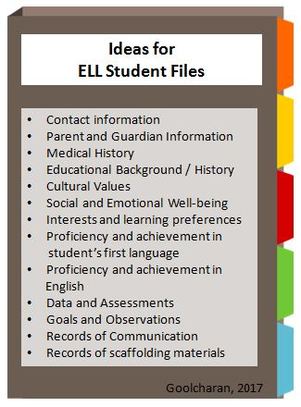
Creating a Welcoming School Environment
|

|
Toolkit Resources: Getting Started with Procedures and Routines
|
Assessment and the SIOP Model
|
We need to accurate identify the level of English Language Learners.
Sheltered Instruction Observation Protocol (SIOP) has 8 interrelated components: 1. Lesson preparation: Include language and content objectives 2. Building background: Connecting to lives and vocabulary knowledge 3. Comprehensible input (visuals, charts, manipulatives 4. Strategies: Cognitive and meta-cognitive strategies 5. Interaction: Repetition, modalities 6. practice/application (use all 4 language skills), lesson delivery and review and assessment. |
45 minute webcast with Dr. Short about English Language Learners and SIOP teaching model. Sheltered Instruction Observation Protocol (SIOP model teaching strategies).
|

|
Toolkit Resources: SIOP & Assessment
|
Differentiation: Success for all Learners including ELLs
|
Differentiated Instruction & Learning
There are many different strategies to reach all learners and English Language learners in a mainstream classroom. One of the key components of a classroom with diverse learners is differentiation. This is a key strategy in providing English Language Learners with the supports they need in a mainstream classroom. Why is it so useful and frequently discussed among educators? First of all, differentiated instruction and learning provides students with many ways to reach the same learning goal. However, planning and implementing differentiation can be challenging. When planning for differentiation, it may help to think of the 3 main areas where differentiation usually occurs: 1. Content: What information do learners need? How will they get the information? 2. Process: What processes will students use to learn the skill 3. Product & Assessment: How will students apply the knowledge and skills? How will their learning be assessed?
Note: Assessment can include pre-assessment, continuous, formative and summative *SC- Student Choice Goolcharan, 2017
Educators decide if one or more areas in their lesson plans will be differentiated. Here is an overview of two lessons using all three areas: content, process and product and assessment. One lesson is about reading, visualization and students create a hanging storyboard. The other lesson is about writing summaries.
Anstee (2011) discusses differentiation on a continuum and suggests educators need to find the right place on the continuum for them and their students. Too little differentiation treats all students the same and neglects individual needs and too much differentiation may make the class chaotic, without focus and teacher and student may not be able to cope. The idea of the continuum reminds educators that differentiation is adaptable and they are not in a fixed position. He identifies several areas of differentiation including by task, resource, support, dialogue and questioning, pace, independence and responsibility and outcome. 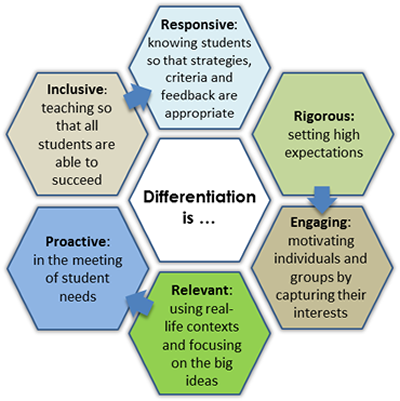
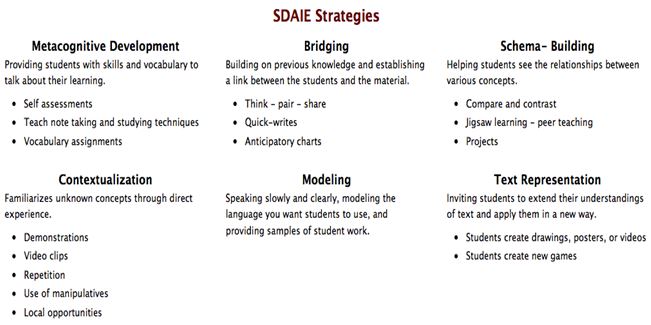
Specially Designed Academic Instruction in English (SDAIE) is a teaching approach. It helps with building academic language in many subject areas. Below are some strategies in SDAIE. There are many that can be used to differentiate in the classroom.
|
Students learn at different rates and in different ways. Learning differences are valued. Differentiation includes multiple opportunities to explore concepts. To implement, educators need to know students and know how and when to use multiple teaching and learning strategies. Assessment for learning helps educators make flexible groupings to meet the needs of all students.

|

|
Toolkit Resources: Strategies for English Language Learners
|
Lisa Goolcharan, 2017. Updated 2018
REFERENCES
Anstee, P. (2011). Differentiation pocketbook. Alresford, Hampshire: Teachers' Pocketbooks.
Derewianka, B., & Jones, P. (2012). Teaching language in context (2nd ed.). South Melbourne, VC: Oxford.
Crawford, J. (2004). Educating English learners: Language diversity in the classroom (5th ed.). Los Angeles, CA: Bilingual Educational Services.
Grosjean, F. (1989). Neruolinguists, beware! The bilingual is not two monolinguals in one person. Brain and Language, 36, 3-15.
Hoff, E. (2017). Bilingual development in children of immigrant families. Child Development Perspectives, 12, 80-86.
Hoff, E., Core, C., Place, S., Rumiche, R., Señor, M., & Parra, M. (2012). Dual language exposure and early bilingual development. Journal of Child Language, 39, 1-27.
Meskill, C. (2005). Infusing English language learners issues throughout professional educator curricula: The training all teachers project. Teachers College Record, 107, 739-759.
Reyes, A. (2006). Reculturing principals as leaders for cultural and linguistic diversity. In K. Tellez & H. C. Waxman (Eds.), Preparing quality educators for English language learners: Research, policies, and practices (pp. 145-165). Mahwah, NJ: Lawrence Erlbaum.
Ruiz, R. (1984). Orientations in language planning. NABE Journal, 8, 15-34.
Shields, C. M. (2013). Transformative leadership in education: Equitable changes in an uncertain and complex world. New York, NY: Routledge.
Theoharis, G., & O'Toole, J. (2011). Leading inclusive ELL: Social justice leadership for English language learners. Educational Administration
Quarterly, 47, 646-688.
Derewianka, B., & Jones, P. (2012). Teaching language in context (2nd ed.). South Melbourne, VC: Oxford.
Crawford, J. (2004). Educating English learners: Language diversity in the classroom (5th ed.). Los Angeles, CA: Bilingual Educational Services.
Grosjean, F. (1989). Neruolinguists, beware! The bilingual is not two monolinguals in one person. Brain and Language, 36, 3-15.
Hoff, E. (2017). Bilingual development in children of immigrant families. Child Development Perspectives, 12, 80-86.
Hoff, E., Core, C., Place, S., Rumiche, R., Señor, M., & Parra, M. (2012). Dual language exposure and early bilingual development. Journal of Child Language, 39, 1-27.
Meskill, C. (2005). Infusing English language learners issues throughout professional educator curricula: The training all teachers project. Teachers College Record, 107, 739-759.
Reyes, A. (2006). Reculturing principals as leaders for cultural and linguistic diversity. In K. Tellez & H. C. Waxman (Eds.), Preparing quality educators for English language learners: Research, policies, and practices (pp. 145-165). Mahwah, NJ: Lawrence Erlbaum.
Ruiz, R. (1984). Orientations in language planning. NABE Journal, 8, 15-34.
Shields, C. M. (2013). Transformative leadership in education: Equitable changes in an uncertain and complex world. New York, NY: Routledge.
Theoharis, G., & O'Toole, J. (2011). Leading inclusive ELL: Social justice leadership for English language learners. Educational Administration
Quarterly, 47, 646-688.
|
Diversity is Our Reality. Inclusion is Our Choice.
Winnipeg, Manitoba Canada |

© Copyright 2017 Inclusion Canada All rights reserved
Created, Designed, Developed and Written by L. Goolcharan
Created, Designed, Developed and Written by L. Goolcharan